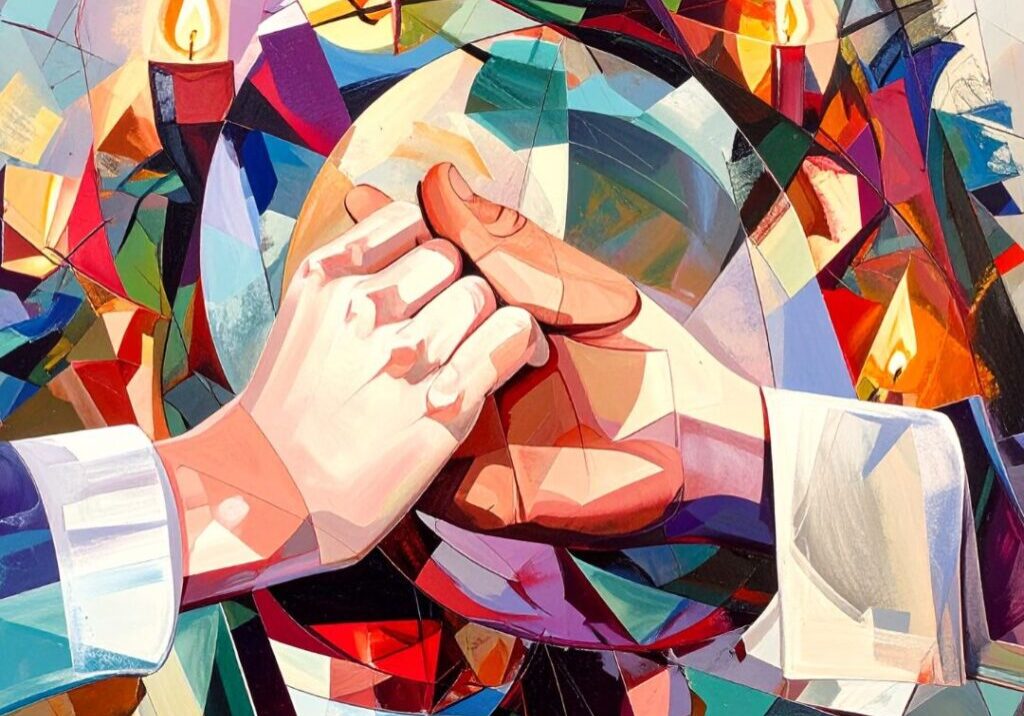
The Unraveling: How Monotheism Severed Humanity from Its Cosmic Roots
Although countless commentators analyze the crises of our age, I am haunted by a more fundamental question: What conditions have made possible the election of manifestly unfit political leaders across the democratic world? How is it that we—a society with unprecedented access to education, information, and scientific knowledge—find ourselves living under increasingly barbaric conditions? We can sequence genomes, split atoms, and photograph distant galaxies, yet we cannot prevent the rise of demagogues, the spread of brazen lies, or the descent into political tribalism that treats opponents as enemies to be destroyed rather than citizens to be persuaded.
The discrepancy is staggering. We know more about the universe than any previous generation, yet we seem to understand less about how to live together in it. We have technologies that connect billions of people instantaneously, yet our societies fragment into isolated echo chambers. We possess the scientific knowledge to address climate change, yet we lack the collective will to act. We understand the neurological basis of empathy, yet cruelty appears normalized in our public discourse.
Where have we missed the mark? This is not merely a question of policy failures or inadequate education or the corrupting influence of money in politics—though all of these matter. I contend that our crisis runs much deeper, to the very foundations of how Western civilization has understood the relationship between humans, cosmos, and the sacred. We are reaping the consequences of conceptual seeds planted centuries ago, theological and philosophical assumptions so thoroughly internalized that we no longer recognize them as choices rather than inevitabilities.
The chaos of our age—the political dysfunction, the epidemic of lying and deception, the violence, the reduction of humans to expendable data points in service of systems—reflects a fundamental disconnect. Despite everything science tells us about our profound interconnection with each other and the cosmos, we act as if we are isolated, cut off from our roots in the evolutionary and cosmic story. We know we are stardust, yet we treat each other as dirt. We understand quantum entanglement, yet we live as if separation were the deepest truth. We trace our lineage back fourteen billion years, yet we cannot trust each other or the earth that birthed us. This essay explores why.
We live in an age of spectacular contradictions. While quantum physics reveals the fundamental interconnectedness of all reality, while evolutionary biology illuminates our profound embeddedness in the web of life, while cosmology traces our atomic lineage to stellar furnaces billions of years old—we act as strangers to this universe. We fragment what cannot be fragmented. We isolate what is intrinsically relational. And in this severing lies the chaos of our time: political systems that reduce persons to data points, violence that treats human beings as expendables, an ecological crisis born of treating Earth as dead matter, and a proliferation of lies and deceptions that suggest we have lost any shared sense of reality itself.
The sciences speak in unison about the fundamental nature of existence. Quantum entanglement demonstrates that particles once connected remain mysteriously correlated across vast distances, suggesting that separation is, at some level, an illusion. Mind and matter interpenetrate rather than occupy separate realms. Spacetime itself unfolds dynamically rather than existing as a static container. Evolutionary biology reveals life not as a collection of isolated units but as a continuous process of emergence, each organism a temporary crystallization of relationships extending back to the first self-replicating molecules. As Teilhard de Chardin observed, even as entropy increases in accordance with thermodynamic law, complexity rises—and with it, consciousness. Something within reality “escapes entropy,” he proposed: a core energy, which he identified with love, that resists breakdown and drives the emergence of ever more intricate forms of awareness and connection.
If this is the fundamental character of reality—relational, dynamic, interconnected—why does human civilization appear to be unraveling? Why do our social and political systems seem to operate in direct contradiction to what we know about the nature of existence?
The Monotheistic Revolution and the Birth of Separation
The answer, I contend, lies substantially in the conceptual architecture established by monotheism, and particularly in the specific form Christianity has taken in Western civilization. The monotheistic revolution represented a profound shift in human consciousness—the movement from polytheistic cosmologies in which the divine permeated nature to a paradigm in which One God stood apart from creation. This was not merely a quantitative reduction in the number of deities; it was a fundamental restructuring of the relationship between the sacred and the world.
Christianity intensified this separation through several distinctive theological developments. The emergence of Jesus as personal Savior established a new paradigm: one God, one mediating person, one path to salvation. God became increasingly defined as transcendent power—eternal, unchanging, existing outside space and time. While portrayed as acting within history, this God remained fundamentally unaffected by worldly events, a static perfection observing and judging a fallen creation from beyond its boundaries.
This theological architecture carried profound implications. If God exists outside the cosmos, then the cosmos itself is evacuated of inherent divinity. Nature becomes mere creation, not creator; matter becomes passive, not sacred. A hierarchy crystallizes: spirit over matter, eternal over temporal, transcendent over immanent, supernatural over natural. The human person is positioned between these realms—neither fully divine nor merely material, but fallen, corrupted, in need of rescue from outside.
From Theology to Cosmology: The Mechanistic Universe
The full consequences of this separation became apparent with the rise of modernity. The scientific revolution, paradoxically emerging from a Christian cultural matrix, built upon this theological foundation of divine transcendence. If God is the external architect and lawgiver, then nature operates according to imposed laws, mechanical principles established from outside. Descartes formalized the dualism: mind distinct from matter, consciousness separate from physical extension. Newton’s clockwork universe required a clockmaker—but once wound, the mechanism could run without divine intervention.
This mechanistic paradigm proved extraordinarily powerful for manipulating and predicting material phenomena. But it came at a cost. The universe became dead matter in motion. Living beings became complex machines. Eventually, the transcendent God who had authorized this view was no longer necessary to the system—the Laplacian demon who knew all positions and velocities had no need of “that hypothesis.” God was progressively pushed out of the world God had supposedly created, leaving behind a purely material universe governed by blind laws.
The twentieth century did not merely witness violence—it industrialized it, systematized it, and justified it through the very logic of separation that monotheism and mechanistic science had normalized. Two world wars transformed technological prowess into unprecedented slaughter, where poison gas, machine guns, aerial bombardment, and finally atomic weapons demonstrated what becomes possible when humans are viewed through the lens of tactical abstraction rather than sacred interconnection. The Holocaust, the Armenian genocide, the Holodomor, the killing fields of Cambodia, the Rwandan genocide—these were not aberrations but logical extensions of a worldview that had already divided reality into hierarchies of value: spirit over matter, soul over body, chosen over damned, civilized over primitive, Aryan over Jew, productive over unproductive.
The reduction of human beings to statistical aggregates began not in death camps but in the theological imagination that saw persons as either saved or damned, sorted into binary categories by external divine judgment. This categorical thinking migrated seamlessly into modernity’s systems of classification: workers reduced to labor units in industrial capitalism, populations transformed into demographic data for state management, entire peoples designated as expendable obstacles to ideological progress. The Nazi bureaucracy that organized genocide with railroad timetables and punch-card efficiency was the mechanistic worldview applied with horrifying consistency. When IBM machines sorted prisoners by categories for extermination, technology was merely executing the logic that had long since separated humans from their cosmic and relational ground.
The crucial insight is this: when the cosmos becomes dead matter governed by blind laws, and when God is pushed outside this mechanical system into irrelevant transcendence, humans lose their sacred inviolability. If the universe itself has no inherent meaning or purpose, if matter is merely inert stuff to be arranged according to will, then human bodies—also matter—can be treated as raw material for ideological or economic projects. The gas chambers were built on the same philosophical foundation as the factory assembly line: both treat living beings as units to be processed efficiently toward predetermined ends.
The violence of the twentieth century was not a failure of the mechanistic paradigm but its fullest expression. When relationship is severed—when humans are disconnected from cosmos, from divine immanence, from each other—what remains is pure instrumentality. People become means rather than ends, resources rather than relations, problems to be solved rather than sacred mysteries to be honored. Auschwitz and Hiroshima were not contradictions of mechanistic modernity; they were its terrible fulfillment, the revelation of what becomes possible when separation becomes absolute and power becomes asymmetric beyond all accountability. The twentieth century revealed that a civilization built on the theology of separation will eventually separate everything—including humans from their own humanity.
The Technological Savior
From the ashes of this violent modernity arose a new candidate for salvation: the machine. Alan Turing’s question—”Can a machine think?”—represents more than a technical inquiry. It embodies a profound hope: that rationality, calculation, and information processing might rescue us from human irrationality, emotion, and corruption. If the traditional God had failed to prevent catastrophe, perhaps a new deity could be constructed—one made of silicon rather than spirit, but equally transcendent of human weakness.
Artificial intelligence emerged as the technological fulfillment of this vision. The computer, born in the cryptographic urgencies of wartime, became the symbol of postmodern salvation. Here was pure reason uncorrupted by flesh, calculation uncompromised by desire, decision-making freed from bias and limitation. Technology would solve the problems that human nature—that fallen, original-sin-stained nature—had created.
Yet this represents not a break from Christian theology but its secularized continuation. The structure remains identical: humans are flawed and in need of external saving power. Only the source of salvation has shifted from a transcendent God to transcendent technology. The longing for rescue from outside, the distrust of embodied human agency, the dream of perfection beyond the material—these persist, now dressed in the language of algorithms and artificial general intelligence.
The Persistence of Asymmetric Power
Old gods do not die easily. Despite the apparent secularization of Western culture, the structural patterns established by monotheistic Christianity continue to shape institutions and consciousness. The monotheistic religions themselves persist, still teaching belief in a transcendent divine power unaffected by space, time, or worldly change. God remains portrayed as external authority, as power distinct from creation, as male benevolence requiring human submission.
This theological template has translated directly into social and political structures. The pattern of asymmetric agency—of power concentrated in transcendent authority to which subjects must submit—replicates throughout civilization. It appears in church hierarchy and liturgy, where “Father knows best” and the faithful receive truth from above rather than discovering it within. It structures political systems as relationships between governing powers and governed populations, between elected officials who possess authority and citizens who grant but then submit to it. It organizes education as transmission from authoritative teachers to passive students, law enforcement as the imposition of order by armed authority upon potential transgressors.
This asymmetry of power proves fundamentally incompatible with what science reveals about reality. If consciousness emerges from matter, if mind and world are not separate categories but aspects of a unified process, if particles across the universe remain entangled in relationship, then authority cannot legitimately reside outside the web of connections. Power concentrated in transcendent centers—whether divine, technological, or political—violates the relational character of existence itself.
Christianity’s doctrine of original sin compounds this structural problem. If humans are essentially corrupted, fallen, incapable of goodness without external grace, then human agency itself becomes suspect. The thinking self cannot be trusted. Desires are dangerous. The body is a source of temptation and sin. Salvation must come from outside—from divine grace, from ecclesiastical authority, from obedience to external law. This anthropology creates a population trained in dependence, in distrust of their own capacities, in looking outside themselves for legitimation and truth. It produces what we might call “agential poverty”—a learned helplessness before the complexity of existence, a reflexive deference to external authority, an inability to trust in the emergent wisdom of interconnected, embodied consciousness.
The consequences appear throughout contemporary society. Political populations vote for authoritarian leaders promising to save them. Individuals outsource their decision-making to algorithms and recommendation engines. Communities fracture because people have not learned to trust the emergent wisdom of genuine dialogue and collective discernment. The chaos of our age—the lying, the violence, the reduction of persons to data—becomes possible precisely because people have been taught not to trust their own agency or the agency of others like them.
The Alternative: Returning to Cosmic Roots
What alternative might exist? The sciences themselves point toward it. Quantum physics reveals a universe not of isolated objects but of relationships and processes. Evolutionary biology shows life as continuous creativity, each organism a unique expression of billions of years of emergence. Cosmology traces our atomic heritage to the deaths of stars, making us quite literally children of the cosmos. Neuroscience demonstrates that consciousness arises from embodied interaction with environment, not from some immaterial ghost in the machine.
Teilhard de Chardin’s insight remains crucial: entropy increases, but so does complexity and consciousness. Something within the universe resists breakdown, drives toward greater intricacy and awareness. He called this energy love—not sentimental emotion but the fundamental force of attraction, relationship, and creative union that builds atoms into molecules, molecules into cells, cells into organisms, organisms into communities, communities into conscious civilizations capable of reflecting on their own cosmic origins.
If we are to address the systems failures of our age, we must abandon the theology of separation that produced them. This does not require abandoning all religious sensibility, but it demands transforming it. Instead of transcendent deity, we might recognize divine creativity within the evolutionary process itself. Instead of humans as fallen individuals needing external salvation, we might understand ourselves as emergent expressions of cosmic creativity, inherently connected to all existence. Instead of asymmetric power structures, we might build institutions that honor the distributed agency of all beings.
This means trusting human communities to discover wisdom through genuine dialogue rather than receiving it from authorities. It means recognizing that political power legitimately belongs to the web of relationships, not to transcendent centers. It means understanding technology as tools for enhancing human connection rather than replacements for human inadequacy. It means treating each person as a sacred node in the network of existence, never as expendable data.
The chaos of our age stems from living according to a cosmology we no longer believe and a theology that contradicts our scientific understanding of reality. We are entangled with all existence, yet we act as isolated individuals. We emerge from evolutionary creativity, yet we treat ourselves as fallen and corrupted. We participate in cosmic becoming, yet we seek salvation from outside.
Until we align our institutions, our ethics, and our self-understanding with what we actually know about the relational, dynamic, interconnected character of reality, the unraveling will continue. The choice before us is whether to persist in the theology of separation—whether in religious or technological form—or to embrace our cosmic roots and build civilization accordingly. The sciences have given us new insights and new knowledge. Whether we have the wisdom and courage to act on it remains the defining question of our time.
 View print-friendly version

Related Posts
The Great Work of Love: Chaos, Justice, and Divine Evolution
The images emerging from Minnesota—multitudes converging in defiance of bitter winter winds, voices rising in collective lament and resistance—continue to command our attention. These are not merely protests; they are…